Foundations
SIP call flow internals, RTP mechanics, and how VoIP traverses a network from endpoint to carrier.
A practical guide to capturing, diagnosing, and resolving VoIP problems.
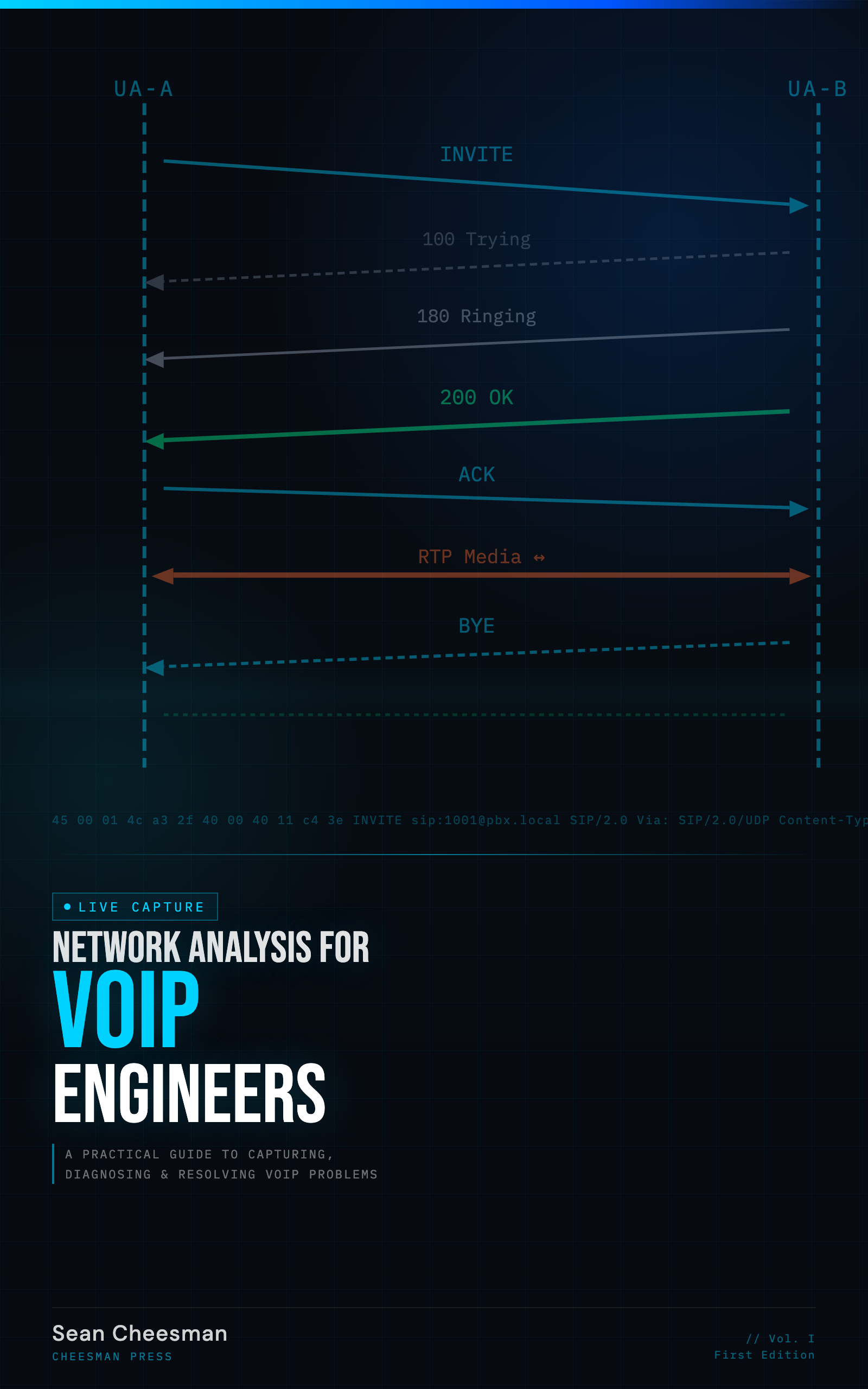
Most VoIP engineers learn to troubleshoot by trial and error — rebooting SBCs, restarting registrations, and hoping the problem resolves itself. Most network engineers understand packets deeply but have never seen a SIP INVITE and aren't sure why one-way audio happens. This book is for both of them.
Network Analysis for VoIP Engineers bridges the gap between protocol theory and real-world production troubleshooting. By the time you finish, you won't just know that there's a problem — you'll know exactly where in the call flow it broke, why it broke, and what to do about it. You'll be reading packet captures the way an experienced clinician reads an X-ray: quickly, confidently, and with a clear diagnosis.
SIP call flow internals, RTP mechanics, and how VoIP traverses a network from endpoint to carrier.
Where and how to capture traffic, the Wireshark VoIP workflow, sngrep for live SIP, and Homer/VoIPmonitor for persistent capture.
One-way audio, choppy calls, dropped calls, registration failures, DTMF issues — each as a worked case with annotated companion captures.
QoS, NAT traversal, firewall/SBC interaction, and how BGP and routing decisions affect call quality.
Building a VoIP observability stack: MOS tracking, CDR analytics, alerting on quality degradation before your customers do.
The book ships with hands-on companions for every Part 3 case file and the broader Wireshark workflow.
A curated collection of annotated .pcap files — one for every scenario in Part 3. Load them in Wireshark and follow along.
Download →Single-page reference for the most useful display filters, color rules, and decode-as settings for SIP and RTP analysis.
Download →Ready-to-import Wireshark profile — color rules for SIP/RTP/RTCP/DTMF/T.38/STUN, tuned column layout, ~20 pre-loaded filters.
Download →Corrections and updates discovered after publication. Bookmark this page if you're working through the book closely.
View →The companions on this site are free and freely redistributable, but they're designed to be read alongside the book. The paperback ties the captures, filters, and case files into a structured walkthrough you can read once and then keep as a reference.