SIP authentication hardening
Digest auth pitfalls in production, mutual TLS for SIP signaling, OAuth and OIDC integration where it fits.
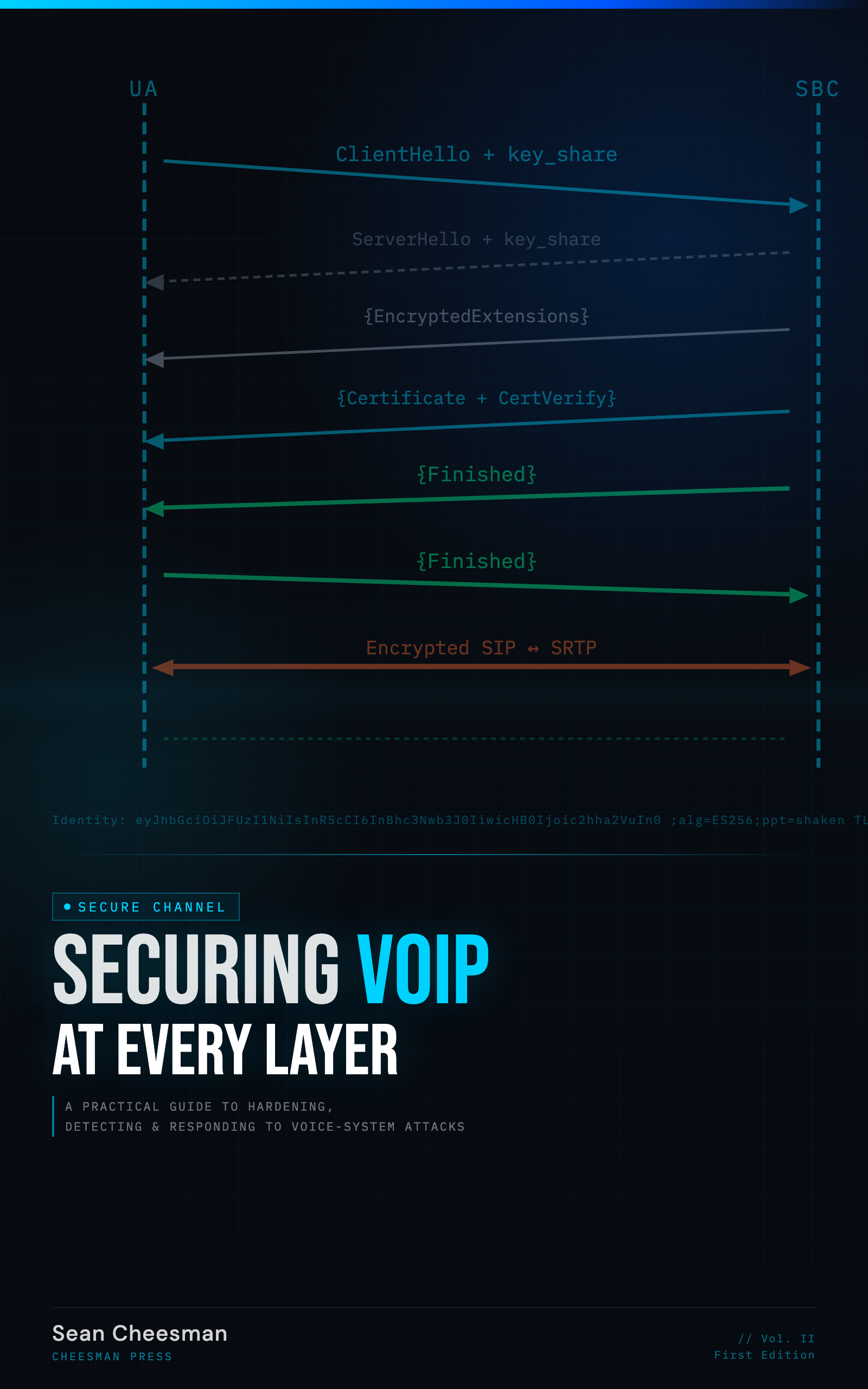
A practical guide to hardening, detecting, and responding to voice-system attacks.
Available in paperback and Kindle on Amazon, with free companion downloads here.
Volume I — Network Analysis for VoIP Engineers — builds the diagnostic discipline of reading VoIP traffic on the wire: capture the call, identify the failure, fix the root cause. Volume II carries that capture-driven methodology into the security space.
The same packet-level fluency that lets you diagnose one-way audio by reading an SDP body also lets you spot toll-fraud reconnaissance in OPTIONS scanning, validate that SRTP is actually encrypting your media, recognize a credential- stuffing attempt in REGISTER traffic, or reconstruct an incident timeline from a HEP archive. The book treats security as something that happens on the wire — and so should the engineer responding to it.
Where Vol I asks why did this call fail?, Vol II asks how do we keep this platform from being attacked, defrauded, or non-compliant — and how do we tell when it is? Read in either order, together the two volumes cover the full operational responsibility of running VoIP for an organization: diagnose, harden, detect, respond.
The book's scope spans three pillars — hardening production VoIP against attack, detecting the attacks that get through anyway, and responding when an incident happens:
Digest auth pitfalls in production, mutual TLS for SIP signaling, OAuth and OIDC integration where it fits.
Call-volume anomaly detection, geo-blocking and destination whitelisting, IRSF mitigation patterns, the operational playbooks that actually work.
Rate limiting, topology hiding, ACL design, attack pattern detection. Configuration patterns for Kamailio, Asterisk, and NetSapiens.
SRTP across the call path, key exchange via SDES / DTLS-SRTP / ZRTP, when each fits, and the gotchas that break interop.
Attestation levels, signing infrastructure, validation chains, and the regulatory landscape — what a working compliance implementation actually looks like.
HIPAA considerations for healthcare VoIP, PCI-DSS for financial services, FCC requirements, data sovereignty across jurisdictions.
Forensic capture for VoIP incidents, breach-detection signals worth alerting on, regulatory notification workflows, and the response playbooks that turn a 3 AM alert into a contained incident.
Network Analysis for VoIP Engineers — paperback and Kindle — builds the capture-driven discipline that Vol II carries into the security space. Companion library of annotated packet captures, Wireshark profile, cheat sheet, and lab guide all included free.